Why Temperature and Weather Change Your Tire’s Performance More Than You Think
Temperature and weather conditions have a direct and often underestimated impact on your tire’s performance, safety, and lifespan. From scorching summer pavement to freezing winter mornings, changes in temperature affect tire pressure, rubber flexibility, tread grip, and overall handling. Even a swing of 10 degrees can alter air pressure enough to influence braking distance, fuel efficiency, and steering responsiveness.
Beyond temperature alone, rain, snow, and extreme heat further change how tires interact with the road. Wet surfaces reduce traction, cold weather stiffens rubber compounds, and excessive heat can accelerate wear and increase the risk of blowouts. Understanding how weather conditions influence tire behavior allows drivers to make smarter maintenance decisions—like checking tire pressure more frequently, rotating seasonally, or switching to weather-appropriate tires—to ensure optimal performance and safety year-round.
Here’s the short version:
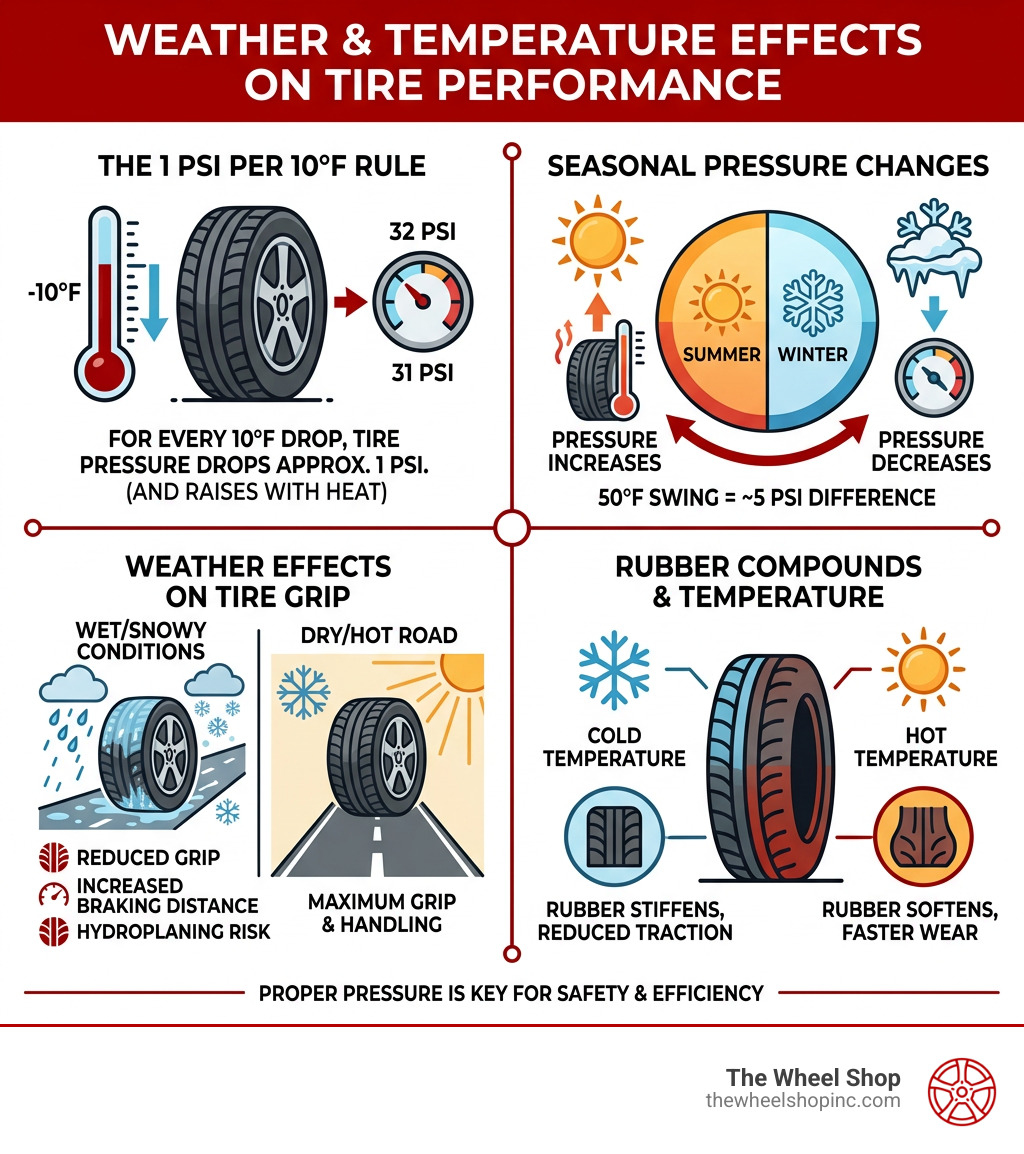
- Cold weather causes air to contract, dropping tire pressure by roughly 1 PSI for every 10°F decrease
- Hot weather causes air to expand, raising pressure and increasing blowout risk
- Rain and snow reduce grip, increase braking distances, and raise hydroplaning risk
- Rubber compounds stiffen in the cold (less grip) and soften in the heat (faster wear)
- Altitude and load also shift pressure independently of temperature
Your tires are the only part of your vehicle touching the road. Everything — braking, handling, fuel economy — runs through them.
Yet most drivers only think about tires when something goes wrong.
A 50°F swing between summer and winter can silently rob your tires of around 5 PSI. That’s enough to affect your fuel costs, your handling, and in the worst cases, your safety — without triggering a single dashboard warning.
Whether you’re commuting in freezing morning temps or cruising on hot summer asphalt, the air inside your tires is constantly reacting to the world outside. Understanding that reaction is the first step to staying safe year-round.
The Science of Tire Pressure and Temperature

At The Wheel Shop, we often see customers surprised when their Tire Pressure Monitoring System (TPMS) light flickers on during the first cold snap of the year. To understand why this happens, we have to look at the basic physics of air.
Air is made of molecules that are constantly in motion. When these molecules get warm, they move faster and push against the walls of your tire with more force—this is thermal expansion. When they cool down, they slow down and huddle together, taking up less space—this is air contraction.
This isn’t just a classroom theory; it has a very real “rule of thumb” in the automotive world. For every 10°F change in ambient temperature, your tire pressure will change by approximately 1 PSI (Pounds per Square Inch). In some heavy-duty applications or high-pressure tires, this shift can even be closer to 2 PSI for every 10°F.
The change is largely due to this relationship between temperature and density. If you set your tires to 35 PSI on a beautiful 80°F Riverside afternoon and then wake up to a 40°F morning, your tires could be sitting at 31 PSI. That might not seem like much, but it’s nearly a 12% drop in pressure!
| Temperature Change | Estimated PSI Shift (Standard) | Estimated PSI Shift (Heavy Duty) |
|---|---|---|
| +10°F | +1 PSI | +2 PSI |
| -10°F | -1 PSI | -2 PSI |
| +30°F | +3 PSI | +6 PSI |
| -30°F | -3 PSI | -6 PSI |
Your Tire’s Performance Changes in Winter
When the temperature drops, the primary risk is underinflation. As the air inside your tires contracts, the tire loses its structural “backbone.” This causes the sidewalls to flex more than they were designed to, which generates excessive heat within the rubber—ironically, your tires can overheat because it’s too cold outside!
Underinflated tires also increase rolling resistance. Think of it like trying to ride a bicycle with soft tires; you have to pedal much harder to move. For your car, this means the engine works harder, leading to poor fuel economy. Beyond the wallet, underinflation ruins your handling. The car may feel “sluggish” or “mushy” during turns, and your braking distances will increase because the tire’s footprint (the contact patch) isn’t hitting the road correctly.
Your Tire’s Performance Changes in Summer
In Riverside, we are no strangers to the heat. When the asphalt temperature starts climbing toward 130°F or higher, the air inside your tires expands significantly. If your tires were already at the high end of their recommended range, the summer sun can push them into overinflation territory.
Overinflated tires become stiff and unyielding. Instead of absorbing road imperfections, they bounce over them, leading to a harsh, uncomfortable ride and reduced traction. Even worse, the center of the tread wears out much faster than the shoulders, shortening the life of your investment.
The ultimate danger of high heat is a blowout. When high ambient temperatures combine with the heat generated by highway driving, the internal pressure can exceed the tire’s structural limits. According to MICHELIN, operating tires can increase in pressure by 1 PSI every 5 minutes for the first 20 minutes of driving. If you start “hot,” you’re asking for trouble.
Impact of Weather on Rubber Compounds and Traction
While pressure is a huge factor, **How Temperature and Weather Change Your Tire’s Performance ** also involves the actual “recipe” of the rubber. Tires aren’t just circles of black plastic; they are complex chemical cocktails designed to operate within specific temperature windows.
Every rubber compound has what scientists call a “glass transition temperature.” This is the point where the rubber stops being flexible and starts becoming brittle, like a piece of hard plastic.
- In the Cold: Standard all-season rubber begins to stiffen as temperatures drop toward freezing. When rubber loses its elasticity, it can’t “conform” to the microscopic irregularities of the road surface. This leads to a massive loss in grip, even on dry pavement.
- In the Heat: Conversely, extreme heat can make rubber too soft. While this might provide great “sticky” traction for a short time, it causes the tread to wear down at an accelerated rate.
We always emphasize How Tread Depth Affects Stopping Distance because as the weather changes, your tread has to do more work. If the rubber is too hard or the tread is too low, you won’t be able to stop in time when it matters most.
Traction Challenges in Rain and Snow
Rain changes the game entirely. When water sits on the road, your tires must act as pumps. The grooves in your tread are designed to channel water away from the contact patch. If the water cannot be moved fast enough, a thin film of liquid builds up between the tire and the road. This is hydroplaning (or aquaplaning).
At speeds as low as 35 mph, a tire with worn tread can lose contact with the road. Those tiny slits you see in the tread blocks (called sipes) are there specifically to bite into ice and move water. Without deep enough tread and flexible rubber, those sipes can’t do their job, and you’re essentially driving on skates.
UV Exposure and Dry Rot
In sunny California, we have to worry about more than just the temperature; we have to worry about the sun itself. UV rays are the enemy of tire longevity. Over time, exposure to intense sunlight causes “outgassing,” where the volatile oils that keep the rubber supple begin to evaporate.
This leads to dry rot—those tiny cracks you see in the sidewalls. Once dry rot sets in, the tire’s structural integrity is compromised. It can no longer handle the stresses of expansion and contraction safely. We recommend parking in the shade whenever possible and keeping your tires clean of harsh chemicals that can strip away protective coatings.
Environmental Factors: Altitude, Load, and Road Conditions
Riverside drivers often head up into the mountains for weekend getaways, and this introduces another variable: altitude. As you climb, the atmospheric pressure outside the tire decreases. Because there is less air pushing against the outside of the tire, the pressure inside the tire effectively increases.
The general rule is that tire pressure increases by about 0.48 PSI for every 1,000 feet of elevation gained. If you drive from sea level to a 5,000-foot mountain peak, your tires will be roughly 2.5 PSI higher than when you started, even if the temperature stayed exactly the same!
Why Load Weight Matters
Load weight plays a critical role in how your tires perform, especially when combined with changing temperatures and road conditions. Every tire is engineered with a specific load rating that determines how much weight it can safely carry. When a vehicle consistently carries heavy cargo, passengers, or towing loads, the added pressure increases heat buildup within the tire. In hot weather, this internal heat rises even faster, which can accelerate tread wear, reduce structural integrity, and increase the risk of a blowout.
In colder temperatures, heavy loads create a different challenge. Cold air reduces tire pressure, and if a tire is already underinflated while carrying excess weight, the sidewalls flex more than intended. This added flexing generates uneven wear and reduces overall handling stability. The combination of underinflation and overloading can significantly compromise braking distance and cornering control, particularly on wet or icy roads where traction is already limited.
Understanding how load weight interacts with temperature helps drivers make smarter maintenance decisions. Checking tire pressure regularly, especially before long trips or when hauling heavy cargo, ensures tires are inflated to the manufacturer’s recommended PSI for the load being carried. Staying within your vehicle’s load capacity and adjusting for seasonal temperature shifts protects tire lifespan, improves fuel efficiency, and most importantly, maintains safe handling in all weather conditions.
Potholes and Seasonal Road Hazards
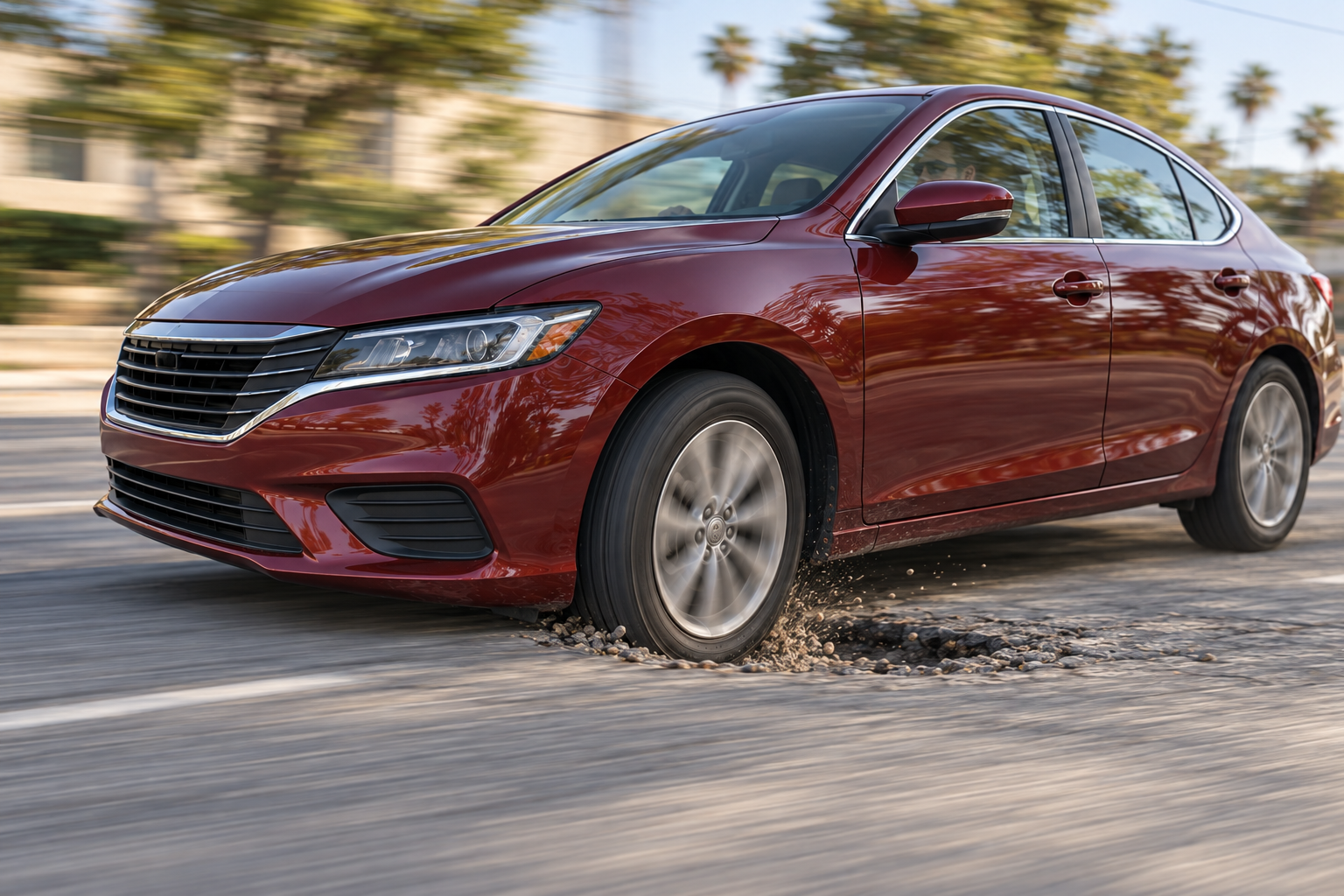
Potholes and seasonal road hazards are another major factor that can dramatically impact tire performance, especially as temperatures fluctuate throughout the year. During winter and early spring, repeated freeze-thaw cycles cause pavement to expand and contract, leading to cracks that eventually form potholes. When a tire strikes one of these depressions—particularly at higher speeds—the sudden impact can damage the tread, weaken internal belts, bend wheels, or even cause immediate air loss. Colder temperatures make tire rubber stiffer, reducing its ability to absorb shock and increasing the likelihood of damage.
Seasonal hazards aren’t limited to potholes. Summer heat can soften asphalt, making roads more susceptible to rutting and surface deterioration, while construction zones often leave uneven pavement edges or debris behind. Heavy rain can conceal potholes under standing water, making them difficult to avoid and increasing the risk of hydroplaning if tread depth is already compromised. Each of these conditions places added stress on tires that may already be affected by temperature-related pressure changes.
To minimize risk, drivers should maintain proper tire inflation, ensure adequate tread depth, and reduce speed on rough or water-covered roads. Regular tire inspections—checking for bulges, sidewall damage, or uneven wear—are especially important after hitting a pothole or navigating poor road conditions. Being proactive about tire care not only extends lifespan but also protects suspension components and ensures safer handling in every season.
Practical Maintenance for Year-Round Performance
So, how do you stay ahead of **How Temperature and Weather Change Your Tire’s Performance **? It all comes down to a few simple habits.
- Check Pressure Monthly: Tires naturally lose 1-2 PSI per month regardless of the weather. When you add temperature swings into the mix, a month is a long time to go without a check.
- The “Cold” Reading Rule: Always check your tire pressure when the tires are “cold.” This doesn’t mean it has to be snowing; it means the car should have been sitting for at least three hours or driven less than a mile. Driving generates friction heat, which can artificially raise your PSI reading by 3-5 pounds.
- Use the Door Placard: Don’t look at the tire sidewall for the correct PSI. Look at the sticker inside the driver’s side door jamb. That is the pressure recommended by the vehicle manufacturer for the best balance of safety and comfort.
- Calibrate Your TPMS: If you adjust your tire pressure, make sure your TPMS system is reset or calibrated according to your owner’s manual so it can accurately alert you to future changes.
When to Consider Seasonal Tire Swaps
While Riverside rarely experiences snow or prolonged freezing temperatures, many drivers regularly travel to mountain communities or other regions where winter conditions are common. If you spend extended time driving in temperatures consistently below 45°F, all-season tires may not provide the traction and control you need. Winter tires are engineered with a specialized high-silica rubber compound that remains flexible in freezing weather, allowing the tread to grip cold, dry pavement as well as snow- and ice-covered roads. That added flexibility translates into shorter stopping distances and improved handling—advantages that standard all-season tires simply can’t match in true winter conditions.
On the other hand, dedicated winter tires should be removed once temperatures consistently rise above the mid-40s. In warmer weather, their softer rubber compound wears down rapidly, especially on hot Southern California pavement. Driving on winter tires during a Riverside summer can quickly “cook” the rubber, reducing tread life dramatically and compromising performance. Understanding how often you should replace your tires isn’t just about mileage—it’s about recognizing how climate, temperature swings, and tire type work together. Choosing the right tire for the season and swapping them at the appropriate time protects your investment, improves safety, and ensures optimal performance year-round.
Frequently Asked Questions about Tire Performance
How often should I check my tire pressure during seasonal changes?
We recommend checking your tire pressure at least once a month. However, during “transitional” months (like fall and spring) where temperatures can swing 30 degrees in a single week, a weekly check is even better. Always check before long road trips, as sustained highway speeds put the most stress on your tires.
Does altitude really change my tire pressure?
Yes! As mentioned earlier, for every 1,000 feet you climb, your tire pressure effectively increases by about 0.5 PSI. If you’re heading from Riverside up to Big Bear, your tires will naturally “expand” as the mountain air gets thinner. If you’re already at the max limit, it’s worth a quick check when you reach your destination.
Why does my TPMS light turn on only in the morning?
This is a classic case of air contraction. Overnight, the cold air causes the pressure to drop just below the TPMS sensor’s threshold. Once you start driving, the friction of the tire against the road generates heat. This heat expands the air, raising the pressure back above the threshold, and the light turns off. Even if the light goes off, it’s a signal that your “cold” pressure is too low and you need to add a few PSI.
The Wheel Shop Difference
At The Wheel Shop in Riverside, CA, we’ve spent over twenty years helping drivers stay safe on the road. Our team doesn’t just sell tires—we provide peace of mind. Our expert technicians take the time to thoroughly check your tread depth across the entire tire surface, identify any uneven wear patterns that might point to alignment or suspension issues, and help you find the perfect replacement tires for your specific vehicle and driving needs.
We take pride in proper installation, balancing, and alignment because we know these details make all the difference in how your vehicle performs when it matters most. Our comprehensive suspension services work hand‑in‑hand with our tire expertise to ensure your entire vehicle functions as a unified system for maximum safety and performance.
It’s worth remembering that your tires represent your vehicle’s only contact with the road. No safety system—not antilock brakes, not stability control, not even the most advanced collision avoidance technology—can work effectively without adequate tire traction. When you invest in proper tire maintenance and timely replacement, you’re making one of the most important safety decisions possible as a driver.
We’d love to help you maintain that safety margin. Stop by The Wheel Shop for a free tire inspection and tread depth check. No pressure, no upselling—just honest assessments and clear recommendations from friendly folks who genuinely care about keeping you and your family safe on the road.
Drive safe, check your tread regularly, and remember that when it comes to tire tread, the legal minimum is just that—a minimum, not a target. Your safety is worth so much more.