Why Tire Maintenance Matters
Extending the lifespan of your tires not only saves you money but also enhances your safety every time you get behind the wheel. With consistent care and smart driving habits, you can protect your tire investment, improve fuel efficiency, and maintain optimal vehicle handling. Simple steps such as keeping your tires properly inflated, rotating them regularly, and monitoring tread wear can make a significant difference—helping you get the most out of every mile.
Here’s a quick summary of the most effective tire maintenance practices:
- Check tire pressure monthly – Properly inflated tires last longer and improve fuel economy by up to 3.3%
- Rotate tires every 5,000-8,000 miles – Ensures even wear across all tires
- Maintain proper wheel alignment – Prevents uneven and premature tread wear
- Balance tires regularly – Eliminates vibration that causes uneven wear
- Drive smoothly – Avoid harsh acceleration, braking, and sharp turns
- Check tread depth – Use the penny test to monitor wear
- Use season-appropriate tires – Switch between winter and summer tires when temperatures cross 45°F
According to the National Highway Traffic Safety Administration, tire issues are a factor in one out of every eleven vehicle crashes. That statistic alone highlights why proper tire maintenance isn’t just about saving money—it’s about keeping you and your passengers safe.
Tires naturally lose about 1 PSI of pressure monthly, and temperature changes can further affect inflation levels. Underinflated tires flex more, creating heat and increasing rolling resistance. This not only wears out your tires faster but also reduces fuel efficiency and compromises handling.
Let’s explore how simple maintenance practices can dramatically extend your tires’ useful life and improve your vehicle’s performance.
1. Keep Your Tires Properly Inflated
Have you ever noticed how a well-inflated basketball bounces perfectly, while a deflated one just thuds against the floor? Your tires work the same way! Proper tire inflation might seem like a small detail in your car maintenance routine, but it’s actually the cornerstone of tire longevity. Yet surprisingly, about 70% of vehicles on the road today have at least one tire with inflation issues – that’s a lot of us driving around on less-than-ideal rubber.
Your tires naturally lose about 1 PSI of pressure every month, even when there’s no visible damage. It’s just physics – those tiny air molecules gradually find their way through the rubber compound. And when the temperature drops in winter? Your tire pressure drops right along with it (and rises when it’s warmer outside).
“Underinflated tires wear out faster, increase fuel consumption, and can even cause blowouts,” explains our lead technician at The Wheel Shop. “Many drivers don’t realize their tires are underinflated until significant damage has already occurred.”
While modern vehicles come equipped with Tire Pressure Monitoring Systems (TPMS) that light up your dashboard when there’s a problem, these systems typically only alert you when pressure falls dangerously low – often 25% below what’s recommended. That means you could be driving on significantly underinflated tires without any warning lights at all!
Pro Tip: Consider investing in a portable air compressor for quick adjustments at home. This small investment can save you frequent trips to the gas station and ensure your tires are always properly inflated.
For the best tire performance and lifespan, I recommend checking your tire pressure at least once a month and before any long road trips. Here’s a simple trick: pick a specific day each month (maybe the 1st or your payday) and make tire checks part of your routine – your tires will thank you with thousands of extra miles!
Learn more about our Tires selection and services at The Wheel Shop.
Tire Pressure Tips
Timing matters when checking tire pressure. Always measure when tires are “cold” – meaning your car has been parked for at least three hours or you’ve driven less than a mile at moderate speed. Why? Because driving heats up your tires, which increases pressure readings and can lead to inaccurate adjustments.
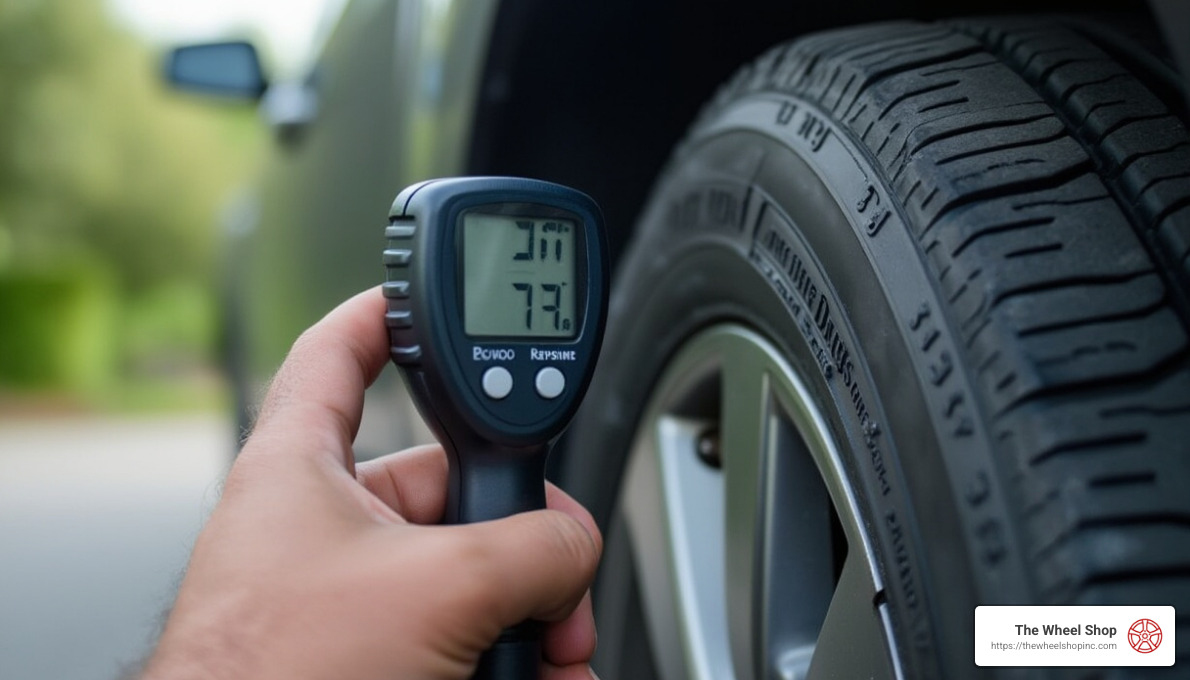
Checking your tire pressure isn’t complicated, but it does require a bit of know-how. First, find your vehicle’s recommended tire pressure – it’s usually listed on a sticker inside your driver’s door jamb, in the glove compartment, or in your owner’s manual. (Pro tip: Don’t use the pressure listed on the tire sidewall – that’s the maximum pressure the tire can handle, not what your specific vehicle needs!)
Invest in a quality digital or dial gauge rather than relying on those built-in gauges at gas stations, which often get knocked around and lose accuracy. Remove the valve cap, press the gauge firmly onto the valve stem until that hissing sound stops, and read the number. Add air if you’re too low, release some if you’re too high, and don’t forget to put that valve cap back on – it keeps dirt and moisture out of your valve.
Keeping your tires properly inflated isn’t just about longevity – it’s also about saving money. Proper inflation can improve your fuel efficiency by up to 3.3%, which adds up to significant savings over time. Plus, properly inflated tires provide better traction, handling, and braking performance, keeping you and your family safer on the road.
Don’t forget about seasonal adjustments too! For every 10°F change in temperature, your tire pressure changes by about 1-2 PSI. This means you’ll likely need to add some air during those chilly winter months and possibly release a bit during summer heat waves to maintain that perfect pressure sweet spot.
Expanding the lifespan of your tires often starts with this simple maintenance task that takes just minutes each month but can add years to your tire life. At The Wheel Shop, we’re always happy to check your pressure for you if you’re in the neighborhood – just one of the ways we help keep you rolling safely!
2. Rotate, Align & Balance on a Routine Schedule
Think of your tires as a team that works best when everyone shares the load evenly. That’s exactly what rotation, alignment, and balancing do—they ensure your tires wear evenly and last longer. Skipping any of these maintenance tasks is like expecting one team member to do all the work—eventually, something’s going to give out too soon.
Tire Rotation
Ever notice how the front tires on your vehicle seem to wear out faster? That’s completely normal. Front tires handle the bulk of steering duties and often bear more weight from the engine, causing them to wear differently than rear tires.
“Front tires typically show more wear on the outside edges due to turning, while rear tires tend to wear more evenly across the tread,” explains our tire specialist at The Wheel Shop. “Without regular rotation, you might find yourself replacing just your front tires thousands of miles early—a costly and avoidable expense.”
For most vehicles, rotating your tires every 5,000 to 8,000 miles keeps wear patterns balanced. An easy way to remember? Schedule a rotation with every other oil change. The rotation pattern depends on your vehicle’s drivetrain:
For front-wheel drive cars, we move the front tires straight back, while the rear tires come forward and switch sides. Rear-wheel drive vehicles get the opposite treatment. All-wheel drive vehicles often benefit from cross-rotation patterns, but your owner’s manual provides the final word on what’s best for your specific model.
Wheel Alignment
Proper wheel alignment is like making sure your shoes point straight ahead when you walk—it prevents awkward wear and tear. When your wheels are properly aligned, they sit perpendicular to the ground and parallel to each other, ensuring your vehicle tracks straight without pulling to one side.
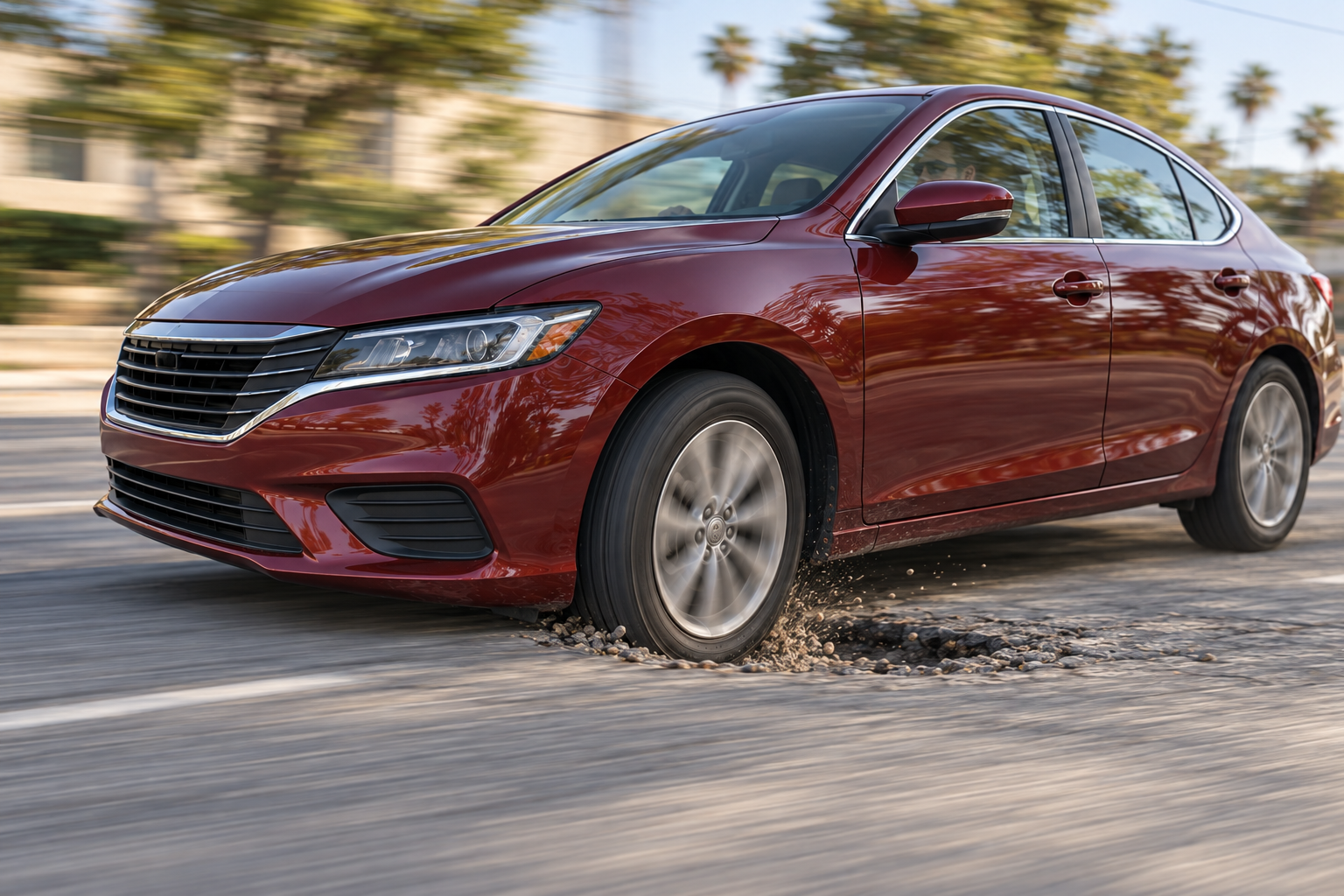
Unfortunately, everyday driving hazards can knock your alignment out of whack. That innocent-looking pothole you hit last week? It might have shifted your alignment just enough to start causing uneven tire wear.
You might need an alignment if:
- Your car drifts to one side on a straight, level road
- Your steering wheel sits crooked when driving straight
- Your tires show uneven or unusual wear patterns
- You hear squealing when turning corners
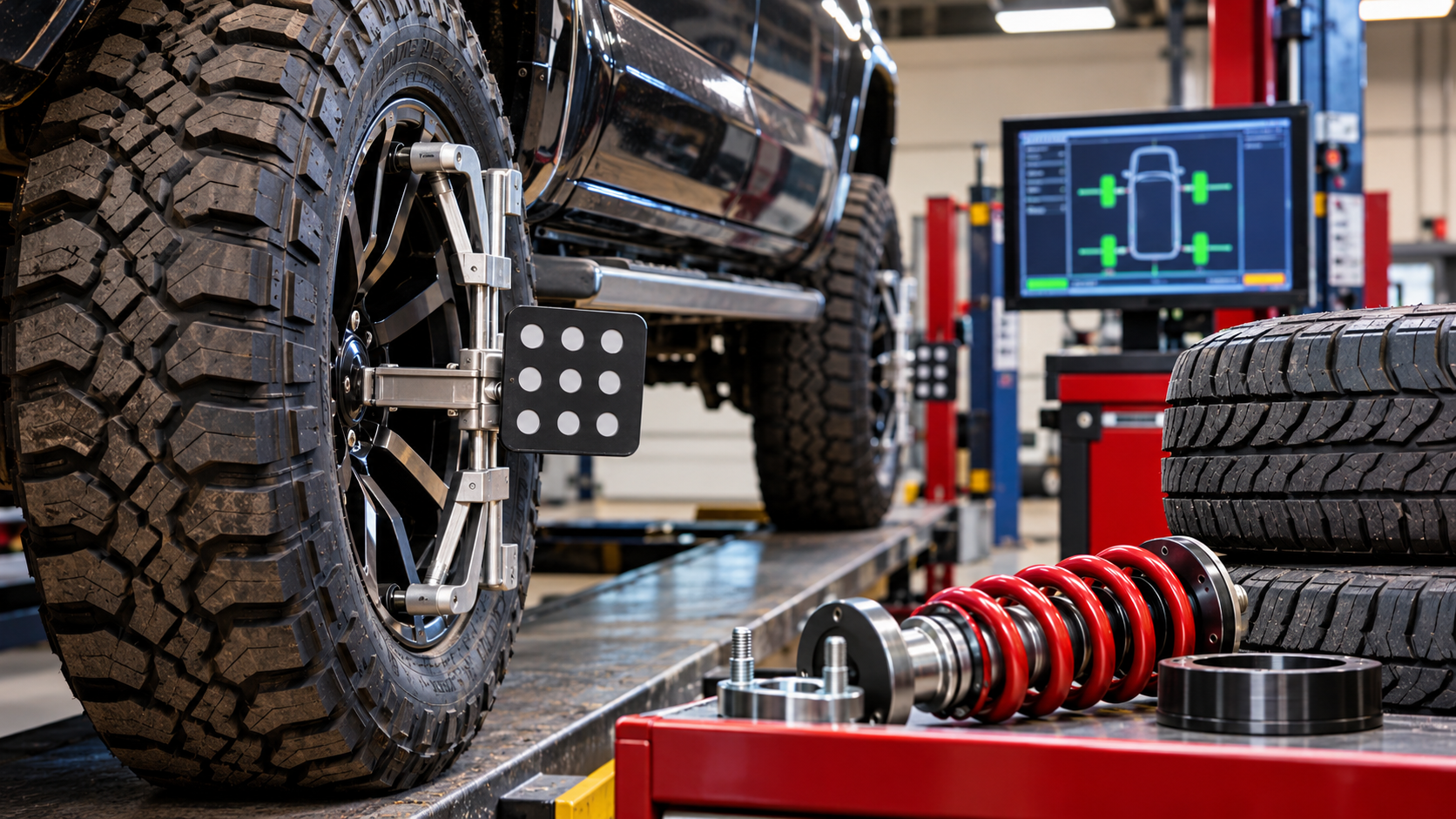
At The Wheel Shop, we recommend alignment checks twice yearly or right after encountering a significant road hazard. Our Precision Wheel Alignment & Balancing service uses computerized equipment to restore factory-specified alignment angles, protecting both your tires and your wallet.
Tire Balancing
Even the finest tires aren’t perfectly weighted. Each tire and wheel combination has natural heavy spots—tiny weight variations that become noticeable at highway speeds. While a half-ounce imbalance seems trivial, at 70 mph that small difference can create vibrations that wear down your tires and shake up your ride comfort.
You’ll know your tires need balancing when:
- You feel vibrations in your steering wheel, seat, or floorboard at certain speeds (usually between 60-70 mph)
- Your tires develop scalloped or cupped wear patterns
- Tire wear appears uneven or premature
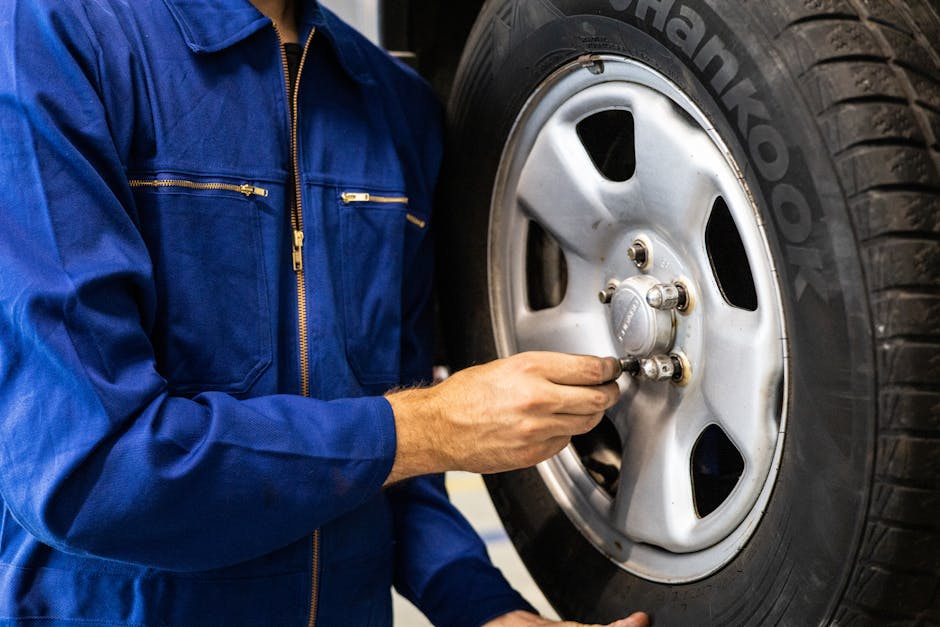
For optimal results, have your tires balanced whenever they’re rotated, when installing new tires, or whenever you notice unusual vibrations. At The Wheel Shop, our technicians use precision equipment to place small weights on your wheels, counteracting those natural heavy spots for a smooth, vibration-free ride.
Visit our Wheel Balancing and Alignment page to learn more about our professional services.
| Service | Purpose | Signs You Need It | Recommended Interval |
|---|---|---|---|
| Rotation | Ensures even wear across all tires | Uneven tread wear between front and rear tires | Every 5,000-8,000 miles |
| Alignment | Keeps wheels perpendicular to ground and parallel to each other | Vehicle pulls to one side, uneven tire wear, off-center steering wheel | Twice yearly or after significant impacts |
| Balancing | Equalizes weight distribution around tire/wheel assembly | Vibration at certain speeds, scalloped tire wear | With rotation, new tire installation, or when vibration occurs |
These three services work together as the foundation of proper tire maintenance. By keeping up with rotation, alignment, and balancing on a regular schedule, you’ll maximize your tire investment and enjoy a safer, more comfortable ride. Tips to extend the lifespan of your tires always include these essential services—they’re simply too important to overlook.
Want to learn more about alignment needs? Check out When should you get a wheel alignment?
3. Adopt Tire‑Friendly Driving Habits — Tips To Extend the Lifespan of Your Tires
The way you drive has a massive impact on how long your tires will last. Even if you’ve invested in premium tires, aggressive driving habits can send them to an early grave. Let’s talk about how small adjustments to your driving style can add thousands of miles to your tire life—while saving you money and keeping you safer on the road.
Smooth Acceleration and Gentle Braking
We’ve all seen those action movies where cars peel out leaving a cloud of smoke behind them. While it might look cool on screen, in real life, that’s literally your tire rubber (and money) being burned away on the asphalt.
“Reckless and fast driving is the most likely instance for tire blowouts,” our senior technician at The Wheel Shop often reminds customers. “Burning rubber is easily preventable and only shortens the amount of time before your next tire replacement.”
Think of acceleration as a gentle press rather than a stomp. Your tires—and wallet—will thank you. The same goes for braking. When you slam on the brakes, you’re essentially grinding your tire tread against rough pavement. Instead, try looking further ahead while driving so you can anticipate stops and slow down gradually. Your passengers will appreciate the smoother ride too!
Mindful Cornering
Taking corners like you’re in a NASCAR race puts enormous sideways pressure on your tires. This side-to-side force wears down the shoulders of your tires—the areas that don’t have the same steel belt reinforcement as the center of your tread.
A simple fix? Slow down before you enter the turn, then maintain a steady speed through it. This approach not only preserves your tires but gives you better control of your vehicle. Safe and economical—what’s not to love?
Avoiding Road Hazards
That pothole you hit last week might be causing more damage than you realize. A single harsh impact can cause internal tire damage that you can’t see but will definitely feel later—possibly at the worst possible moment.

“Even a small curb bump or pothole can knock your alignment out of spec,” explains our alignment specialist. “And misalignment leads to accelerated, uneven tire wear.”
Giving yourself space between your car and the vehicle ahead does more than prevent accidents—it gives you time to spot and safely steer around road hazards. When you can’t avoid that pothole, slowing down before impact can make the difference between a minor bump and a trip to our shop for new tires.
Want to know more about road hazards? Check out our guides on How Potholes Affect Wheels and the Most Common Causes of Wheel Damage.
Respecting Load Limits
Every tire has a weight limit—exceed it, and you’re asking for trouble. Overloaded tires flex more than they should, heat up faster, and wear out quicker. It’s like asking someone to carry a 100-pound backpack when they’re built to handle 50—something’s going to give out sooner than expected.
Not sure about your vehicle’s load capacity? Check the sticker on your driver’s side door jamb or flip through your owner’s manual. If you’re planning to haul a heavy load, consider bumping up your tire pressure slightly (staying within manufacturer recommendations) and taking it a bit slower on the road to reduce heat buildup.
Avoiding Road Shoulders
The edge of the road is where all the road debris goes to rest—nails, glass shards, metal fragments—it’s like a tire’s worst nightmare. Plus, that sharp edge where the main road meets the shoulder can slice into your tire sidewall like a knife.
“Drivers often wonder ‘How did this happen?’ when they find a nail in their tire,” notes our tire repair specialist. “The answer is frequently that they drove on the road shoulder where such debris tends to accumulate.”
Whenever possible, keep your tires on the main traveled portion of the road. If you absolutely must pull onto the shoulder for an emergency, move over slowly and carefully.
Adopting these tire-friendly driving habits isn’t just about extending tire life—though they definitely will. It’s about safer driving, better fuel economy, and spending less time and money on car maintenance. Small changes in how you drive can lead to big savings down the road.
At The Wheel Shop, we’re passionate about helping you get the most out of your tires. After all, they’re the only part of your vehicle that actually touches the road—they deserve a little extra care!
4. Inspect, Measure & Act on Wear
Let’s be honest—most of us don’t think about our tires until there’s a problem. But developing a simple tire inspection habit can save you from that sinking feeling when you hear the flap-flap-flap of a damaged tire on your morning commute. Trust me, your future self will thank you!
Visual Inspections
I recommend giving your tires a quick once-over at least monthly—more often if you regularly battle pothole-riddled streets or extreme weather conditions. Think of it as a health check-up for your tires.
When you’re looking over your tires, pay special attention to the sidewalls. See any cuts, cracks, or bulges? These are red flags signaling internal damage and potential blowout risk. Unfortunately, sidewall damage usually means it’s time for a new tire—these injuries typically can’t be repaired.
“Tires often show early warning signs of problems well before a catastrophic failure,” explains our inspection specialist at The Wheel Shop. “A five-minute check each month can prevent hours of hassle and hundreds of dollars in unnecessary costs.”
While you’re at it, look closely at the tread surface for uninvited guests—nails, screws, glass shards, or other debris. Even if they haven’t caused a leak yet, these intruders can work their way deeper with every mile you drive.
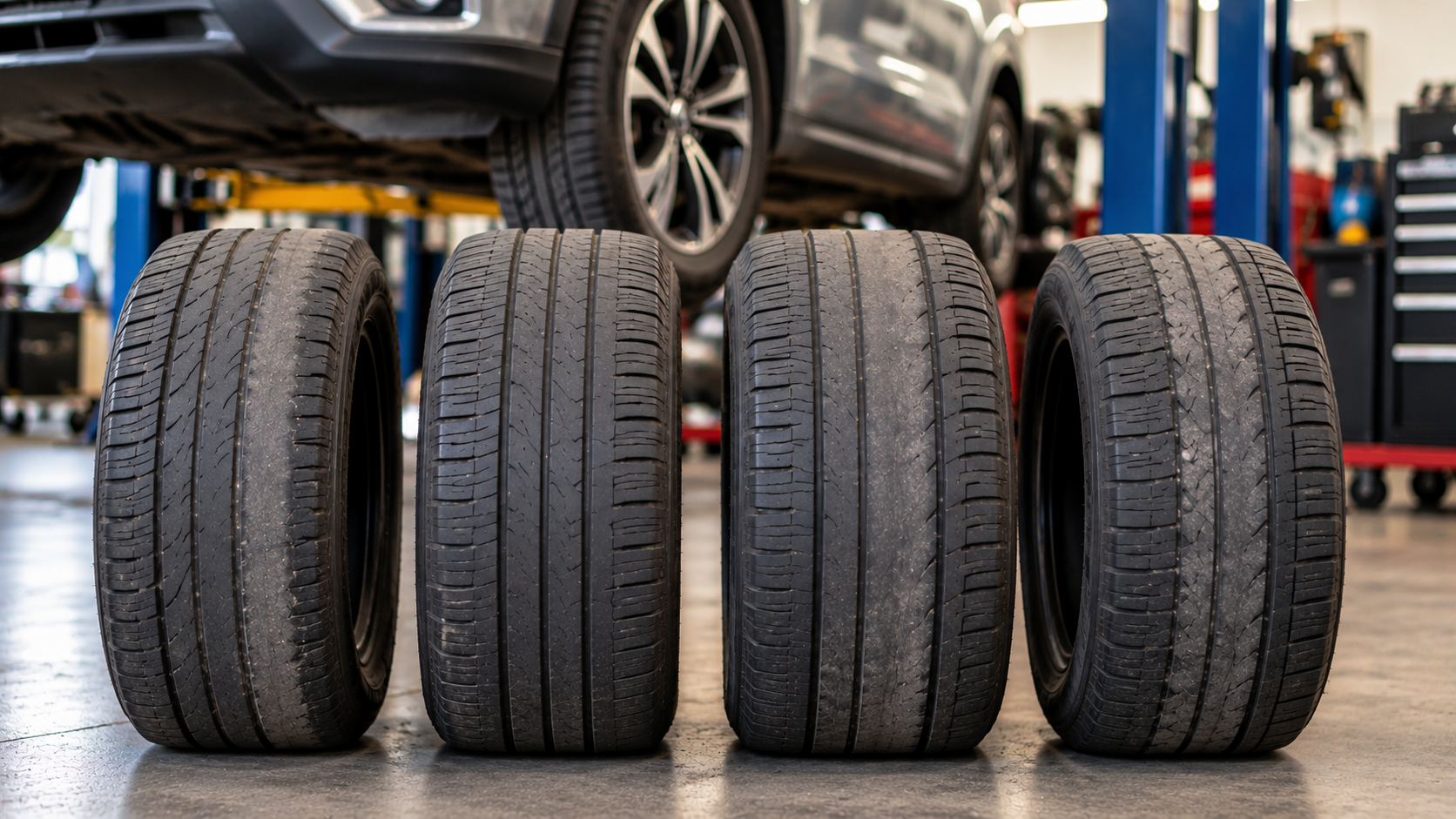
Uneven wear patterns tell an important story about what’s happening with your vehicle. Center wear? You’re probably overinflating. Edge wear on both sides? Likely underinflation. Just one edge wearing down? That points to alignment issues. And if you notice cupping or scalloping (those wavy wear patterns), your suspension might be struggling or your tires need balancing.
Don’t forget to compare wear across all four tires. Significant differences can indicate deeper problems that need addressing.
For more information on tire specifications, visit our page on Understanding Wheel and Tire Dimensions.
Tread Depth Tips
Adequate tread depth isn’t just about passing inspection—it’s about staying safe, especially when those summer thunderstorms hit. As your tires wear down, they lose their ability to channel water away, dramatically increasing your risk of hydroplaning.
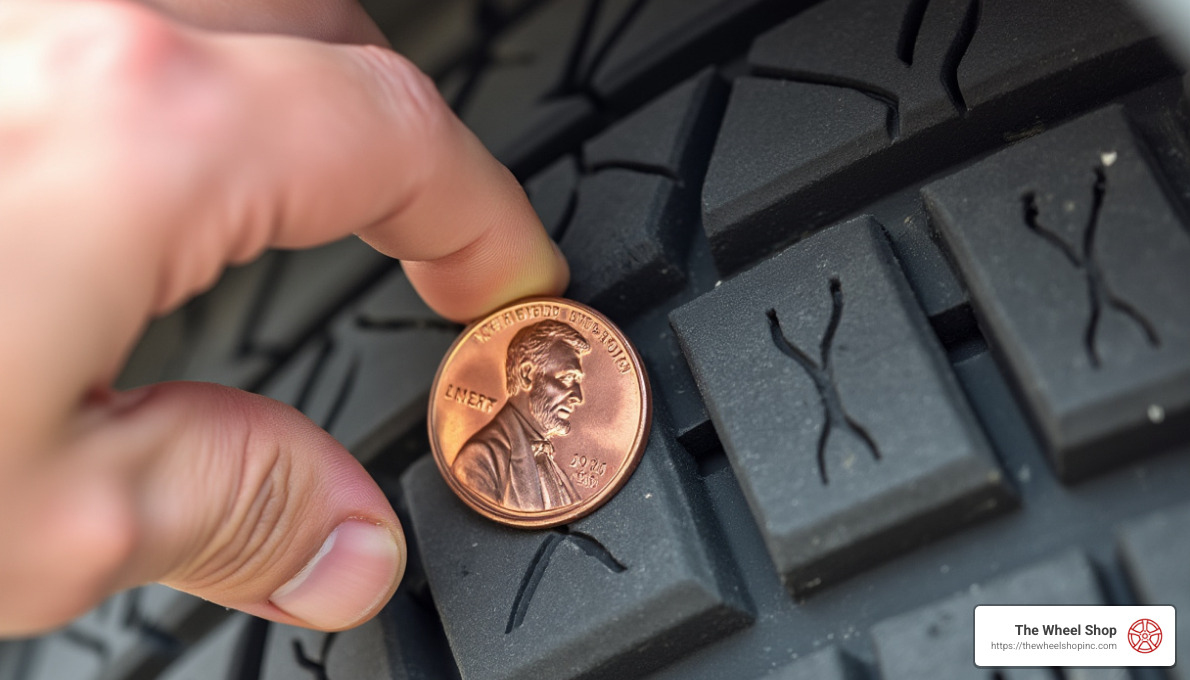
In the U.S., the legal minimum tread depth is 2/32 of an inch (about 1.6 mm)—roughly the distance from the edge of a penny to Lincoln’s head. But here’s the thing: your tire performance starts declining well before hitting this bare minimum. For peace of mind (and better grip in wet conditions), many experts recommend replacement when you hit 4/32 of an inch.
The classic penny test is your easiest measuring tool. Just insert a penny into the tread groove with Lincoln’s head upside down. If you can see all of honest Abe’s head, it’s definitely time for new tires.
Modern tires also come with built-in wear bars—those little rubber strips running perpendicular to your tread pattern. When these become flush with your tread surface, you’ve hit the legal wear limit.
For the most precise measurement, pick up an inexpensive tread depth gauge from your local auto parts store. They’re worth their weight in gold for regular tire maintenance.
According to NHTSA data, about 1 in 10 cars on the road has at least one bald tire. Don’t be that driver—your safety (and everyone else’s) depends on it.
Responding to Tire Damage
Finding damage during your inspection? Don’t procrastinate—take action right away:
For small punctures in the tread area (not the sidewall), professional repair may be possible. At The Wheel Shop, we can evaluate the damage and recommend the safest solution.
If you spot sidewall damage, bulges, or significant tread damage, replacement is typically your only safe option. It might feel like an unexpected expense, but it’s far cheaper than dealing with a blowout on the highway.
Noticing uneven wear patterns? Schedule an alignment check and adjust your inflation pressure as needed. These simple fixes can add thousands of miles to your tire’s useful life.
Age matters too, not just tread depth. Even tires with plenty of tread can become dangerous as they age, as rubber naturally degrades over time. Most manufacturers recommend replacing tires that are 6-10 years old, regardless of how much tread remains. You can find the manufacturing date on the tire sidewall as a four-digit code—for example, “1219” means the tire was made in the 12th week of 2019.
Tips To Extend the Lifespan of Your Tires aren’t just about saving money—they’re about keeping you safe on the road. Regular inspections are one of the simplest yet most effective ways to protect your investment and your family.
5. Seasonal Swaps & Smart Storage
If you’re serious about getting the most mileage from your tires, you need to think about the seasons. Using the right tires at the right time of year—and storing the others properly—isn’t just smart economics; it’s a game‑changer for tire longevity.
Winter vs. Summer Tires
Your tires’ rubber compounds are like specialized athletes—they’re designed to perform in specific conditions. When you use them outside their comfort zone, they not only perform poorly but wear out much faster.
Summer tires become stiff and unresponsive when temperatures fall below 45°F (7°C). That magical 45‑degree mark is when the rubber compounds start to harden, dramatically reducing grip and potentially creating dangerous driving conditions.
Winter tires, with their softer, more pliable compounds, excel in cold weather but quickly wear down on hot summer pavement. It’s like wearing snow boots to the beach—they’ll work, but they’re the wrong tool for the job.
All‑season tires try to be the jack‑of‑all‑trades but master of none. They’re convenient but won’t match the performance of season‑specific tires in extreme conditions.
“I’ve seen customers burn through winter tires in just one hot California summer,” shares our senior tire technician at The Wheel Shop. “That soft rubber that grips so well on ice just melts away on hot asphalt. It’s like watching money evaporate.”
For our Riverside, CA customers, all‑season tires often make the most sense year‑round. But if you regularly head up to Big Bear or Mammoth for winter trips, investing in a dedicated set of winter tires for those journeys could save you money (and possibly your life) in the long run.
Road Hazard Warranty Consideration
Let’s face it—no matter how carefully you drive, road hazards happen. That’s why a good road hazard warranty can be worth its weight in gold when it comes to protecting your tire investment.
When purchasing new tires, don’t automatically dismiss the road hazard protection as an unnecessary upsell. A quality warranty typically covers damage from potholes, nails, glass, and other unavoidable road debris that can cut your tire’s life short.
The best road hazard warranties offer free tire replacement in the first few years, prorated replacement afterward, complimentary puncture repairs, and coverage for damage that can’t be fixed. While this protection adds to your upfront cost, it can save you hundreds if you hit that unavoidable pothole on your commute.
“We had a customer hit a construction debris patch on the 91 freeway last month,” recalls our service manager. “Two tires were damaged beyond repair. Thankfully, his road hazard warranty covered both replacements completely—saving him over $400.”
For more information on upgrading your wheels while maintaining proper fitment, visit our Guide to Upsizing Custom Wheels.
At The Wheel Shop, we’re happy to help you develop a seasonal tire strategy that makes sense for your driving patterns and budget. Proper seasonal swaps and smart storage aren’t just about extending tire life—they’re about maximizing performance and safety in all driving conditions.
FAQS
Frequently Asked Questions about Tire Lifespan
How often should I check and adjust tire pressure?
You should check your tire pressure at least once monthly and before any long road trips or when hauling heavy loads. The best time to check is when your tires are “cold”—meaning your vehicle has been parked for at least three hours or driven less than a mile at moderate speed. Seasonal temperature swings can dramatically affect pressure levels, so you might need more frequent checks during fall and spring when temperatures fluctuate most. Even without any punctures or damage, tires naturally lose about 1 PSI every month through normal permeation, making regular checks essential regardless of how much you drive.
When is it time to replace tires even if tread looks fine?
Age matters with tires, even when they look perfectly fine on the surface. Most manufacturers recommend replacement at 6-10 years regardless of tread depth. You can find your tire’s birthday by looking for the four-digit date code on the sidewall (for example, “1520” means the 15th week of 2020). The rubber compounds in tires gradually break down from exposure to oxygen, ultraviolet light, and temperature changes, which compromises performance and safety. Beyond age, immediate replacement is necessary if you spot sidewall bulges or cracks, see exposed internal cords, experience repeated air pressure loss, or feel stubborn vibrations that balancing can’t fix.
What signs show my wheels are out of alignment?
Your vehicle will practically tell you when alignment needs attention—you just need to listen to the signals. The most obvious indicator is when your car drifts to one side on a straight, level road even when you’re holding the steering wheel straight. Other telltale signs include a steering wheel that sits crooked when driving straight ahead, uneven tire wear (especially more wear on inside or outside edges), loose or wandering steering feel, squealing tires during normal turns, or steering wheel vibration that wasn’t there before.
Don’t ignore these symptoms. Continuing to drive with misaligned wheels is like walking with twisted ankles—it creates stress in all the wrong places. Misalignment accelerates tire wear and can compromise handling in emergency situations. At The Wheel Shop, our computer-assisted alignment equipment ensures your wheels meet manufacturer specifications precisely, restoring proper handling and maximizing tire life.
The Wheel Shop Difference
Putting these Tips To Extend the Lifespan of Your Tires into practice isn’t just about being frugal—it’s about making smart investments in your safety and vehicle performance. Think about it: those four patches of rubber are your only connection to the road. When you care for them properly through consistent inflation checks, regular rotation and alignment, gentler driving habits, thorough inspections, and seasonal tire management, you’re potentially saving yourself thousands of dollars over your vehicle’s lifetime.
Here at The Wheel Shop in Riverside, we’ve seen how proper tire maintenance transforms both a vehicle’s performance and its owner’s wallet. Our team brings over twenty years of experience to every service, whether it’s a precision alignment, professional wheel balancing, or helping you select the perfect tires for your driving needs. What sets us apart isn’t just technical expertise—it’s our commitment to helping you understand how and why tire care matters.
Proper tire maintenance creates a virtuous cycle: well-maintained tires improve fuel efficiency, improve handling, provide better braking performance, and deliver a more comfortable ride. They’re less likely to fail at critical moments, keeping you and your passengers safer on every journey.
The small, consistent efforts we’ve outlined throughout this guide might seem minor individually, but their collective impact on your driving experience and budget is significant. Taking care of your tires isn’t complicated—it just requires attention and consistency.
Ready to give your tires the professional care they deserve? Learn more about our comprehensive services at More info about our services.