Why Your Vehicle’s Alignment is Critical for More Than Just Driving Straight
Many drivers assume a wheel alignment is just about keeping the car pointed in the right direction, but the truth runs much deeper. A precise, professional alignment protects far more than your ability to drive straight—it safeguards your tires, suspension, braking performance, and even your fuel efficiency. When every angle is calibrated correctly, your car handles better, your ride feels smoother, and your components last longer.
Beyond comfort, the stakes are real: misalignment can quietly drain your wallet through premature tire wear, unnecessary repairs, and reduced MPG, all while compromising your ability to brake or steer in an emergency. A proper alignment isn’t just a maintenance task—it’s an investment in safety, savings, and the long-term health of your vehicle.
What a Professional Wheel Alignment Really Does:
- Improves safety with better steering stability, predictable handling, and shorter braking distances.
- Extends tire life by up to 20% by preventing uneven wear.
- Improves fuel efficiency by reducing rolling resistance.
- Protects expensive components like suspension and steering parts from premature wear.
- Prevents costly repairs by catching problems early.
If your car pulls to one side or you feel vibrations through the steering wheel, your vehicle is sending warning signs. Most people think alignment just means pointing wheels forward, but it’s far more complex. Three critical angles—camber, caster, and toe—must be precisely set to manufacturer specifications. Even a slight deviation can cause problems throughout your vehicle.
A professional alignment takes about an hour and costs a fraction of what you’d pay for new tires or suspension repairs, making it one of the most cost-effective maintenance services available.
The Core Benefits: Why Alignment is Crucial for Your Entire Vehicle
A proper wheel alignment does far more than correct the direction of your tires—it sets the foundation for your vehicle’s overall performance. When your wheels are aligned with precision, every major system on your car benefits, from steering and suspension to braking, tire longevity, and fuel efficiency. Alignment isn’t just a technical adjustment; it’s a critical service that keeps your vehicle stable, responsive, and protected from unnecessary wear. Understanding these core benefits makes it clear why alignment is essential for the long-term safety, reliability, and value of your entire vehicle.
Enhancing Driving Safety and Control
Properly aligned wheels ensure your vehicle responds predictably to steering inputs. When alignment is off, your car might pull to one side, forcing constant correction, or the steering wheel may sit crooked. These are safety hazards, not just annoyances.
Proper alignment provides optimal steering stability and predictable handling, which is critical during emergency maneuvers like hard braking or swerving. Misaligned wheels reduce road contact, leading to less traction and longer braking distances, especially on wet or icy roads. When wheels fight each other, your car’s ability to grip the road is compromised when you need it most. For more on this, see The Link Between Tread Depth and Stopping Distance.
Maximizing Tire Longevity and Saving Money
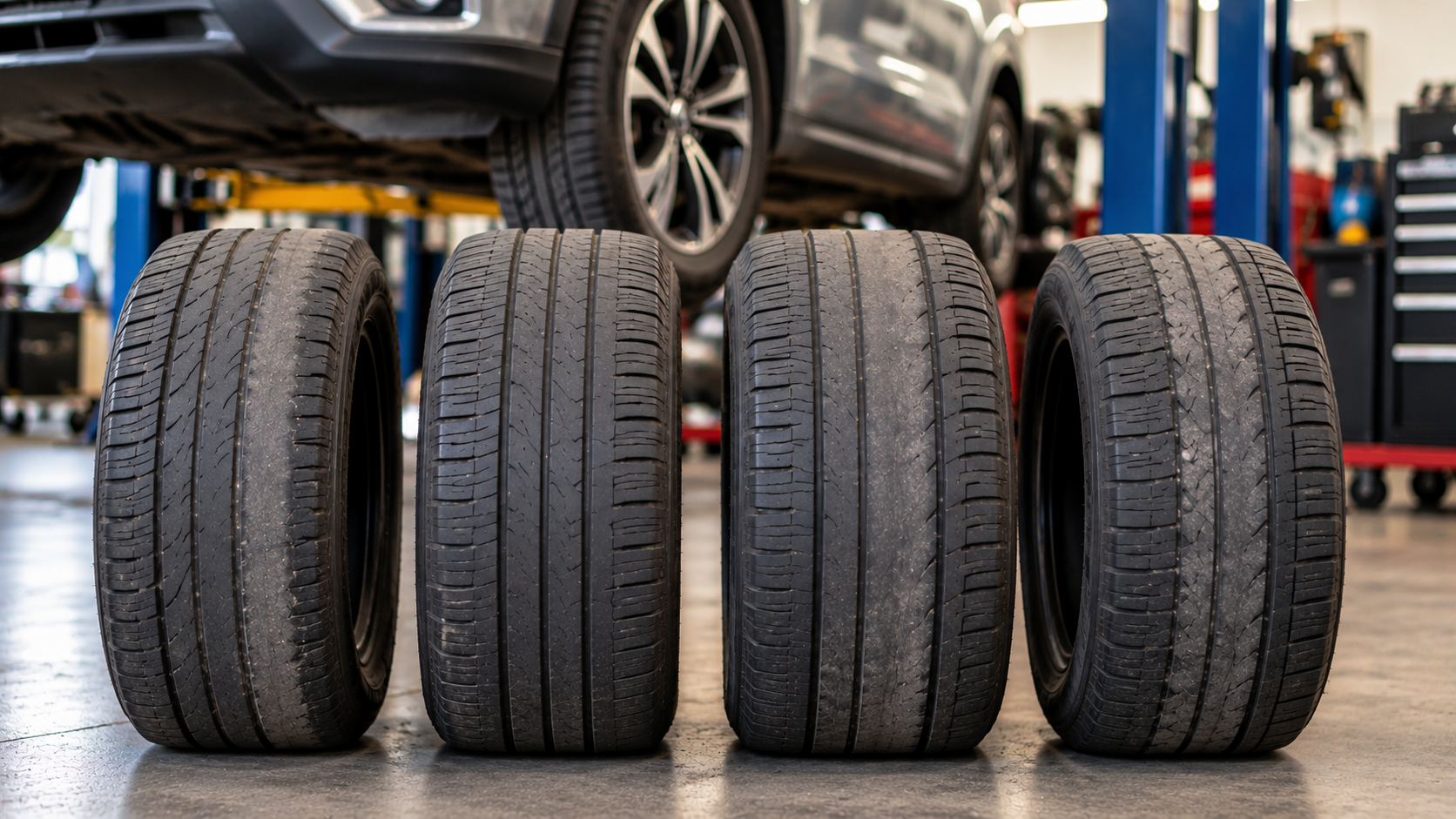
Misalignment causes preventable, uneven tire wear. You might see wear on the inner or outer edges, feathering, or bald spots while the rest of the tread is fine. Research shows that misaligned wheels can cause tires to wear up to 10 times faster than normal.
Once this uneven wear occurs, the tire is permanently damaged and requires premature replacement. A quality set of tires can cost from $400 to over $1,000. In contrast, a proper alignment can extend tire life by up to 20%. This simple service ensures your tires wear evenly and last as long as intended, making it a smart investment. For more tips, read our guide on Tips to Extend the Lifespan of Your Tires.
Improving Fuel Efficiency
Your wheel alignment directly impacts fuel consumption. When wheels are misaligned, they fight each other, creating rolling resistance. This forces your engine to work harder and burn more fuel just to move the vehicle forward.
Over time, this adds up. Poor alignment reduces fuel efficiency, leading to more trips to the gas station. A proper alignment allows your wheels to roll freely, reducing engine strain and improving your fuel economy.
Protecting Your Suspension and Steering Systems

When alignment is off, your vehicle’s suspension and steering systems take a beating. Parts like tie rods, ball joints, control arms, and bushings are put under constant stress, causing them to wear out much faster than they should.
Ignoring alignment can lead to worn ball joints or damaged tie rods, with repairs costing from a few hundred to over $1,000. A routine alignment check is preventative maintenance, catching problems early and reducing stress on these critical parts. It’s about protecting your entire vehicle. Don’t wait for small issues to become major repairs.
The Science of Alignment: Understanding the Angles
Wheel alignment may seem straightforward, but behind the smooth ride and precise steering lies a set of carefully measured angles that determine how your vehicle interacts with the road. Camber, caster, and toe each play a distinct role in stability, tire wear, and overall handling—and even slight deviations can create noticeable performance issues. Understanding these angles isn’t about becoming a mechanic; it’s about knowing how small adjustments can dramatically impact safety, comfort, and the life of your tires.
Camber: The Inward/Outward Tilt
Camber is the vertical tilt of your wheels when viewed from the front.
Negative camber is when the top of the wheel tilts inward. This is common on sports cars to improve cornering grip, but too much will wear the inner tire edges and reduce straight-line stability.
Positive camber is when the top tilts outward. This is usually a sign of a problem and will quickly wear down the outer tire edges.
Caster: The Angle of Steering Stability
Caster is the angle of the steering axis when viewed from the side. Think of a shopping cart’s front wheels—the pivot point is ahead of the wheel’s contact patch. This is positive caster, and it’s what helps the wheel track straight.
Proper caster gives your car straight-line tracking and helps the steering wheel return to center after a turn, providing stability at highway speeds. If caster is off, your steering may feel vague, the car might wander, or it could pull to one side.
Toe: The Direction Your Tires Point
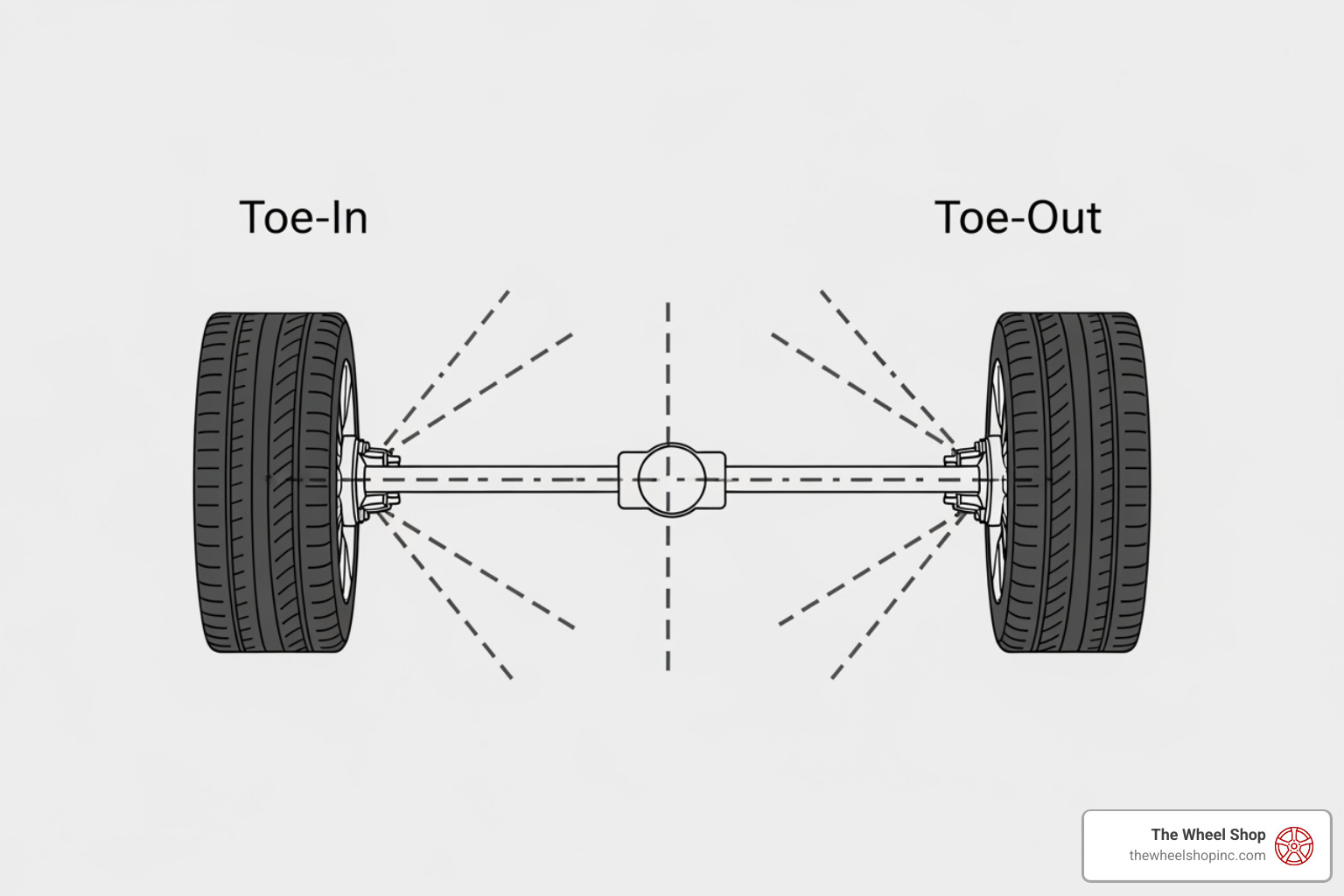
Toe is the direction your tires point relative to each other, as seen from above.
Toe-in means the front edges of the tires angle toward each other, which generally improves stability.
Toe-out means the front edges point away from each other, which can improve steering response.
Toe is the angle most responsible for premature tire wear. Even a tiny deviation causes tires to scrub sideways as they roll, wearing them out incredibly fast. Different drivetrains require different toe settings; for example, rear-wheel drive vehicles often use slight toe-in, while front-wheel drive vehicles may use slight toe-out to compensate for driving forces.
We set toe to the manufacturer’s exact specifications—a matter of fractions of an inch—which can be the difference between tires that last 50,000 miles and tires that are worn out at 20,000.
The Alignment Service Explained
A professional alignment service goes far beyond simply “straightening” your wheels. It’s a detailed process where technicians measure and adjust the angles of your tires—camber, caster, and toe—to ensure they meet the manufacturer’s precise specifications. Using advanced diagnostic equipment, they identify misalignments that can cause uneven tire wear, steering pull, or handling issues, then correct them to optimize performance. The result is a vehicle that drives true, handles predictably, and protects your tires, suspension, and overall safety on the road.
What to Expect During a Professional Service
First, our technicians perform a thorough inspection. We check your tires for wear patterns and inspect suspension and steering components for damage. If parts like tie rod ends or ball joints are worn, they must be replaced before an alignment can be done correctly.
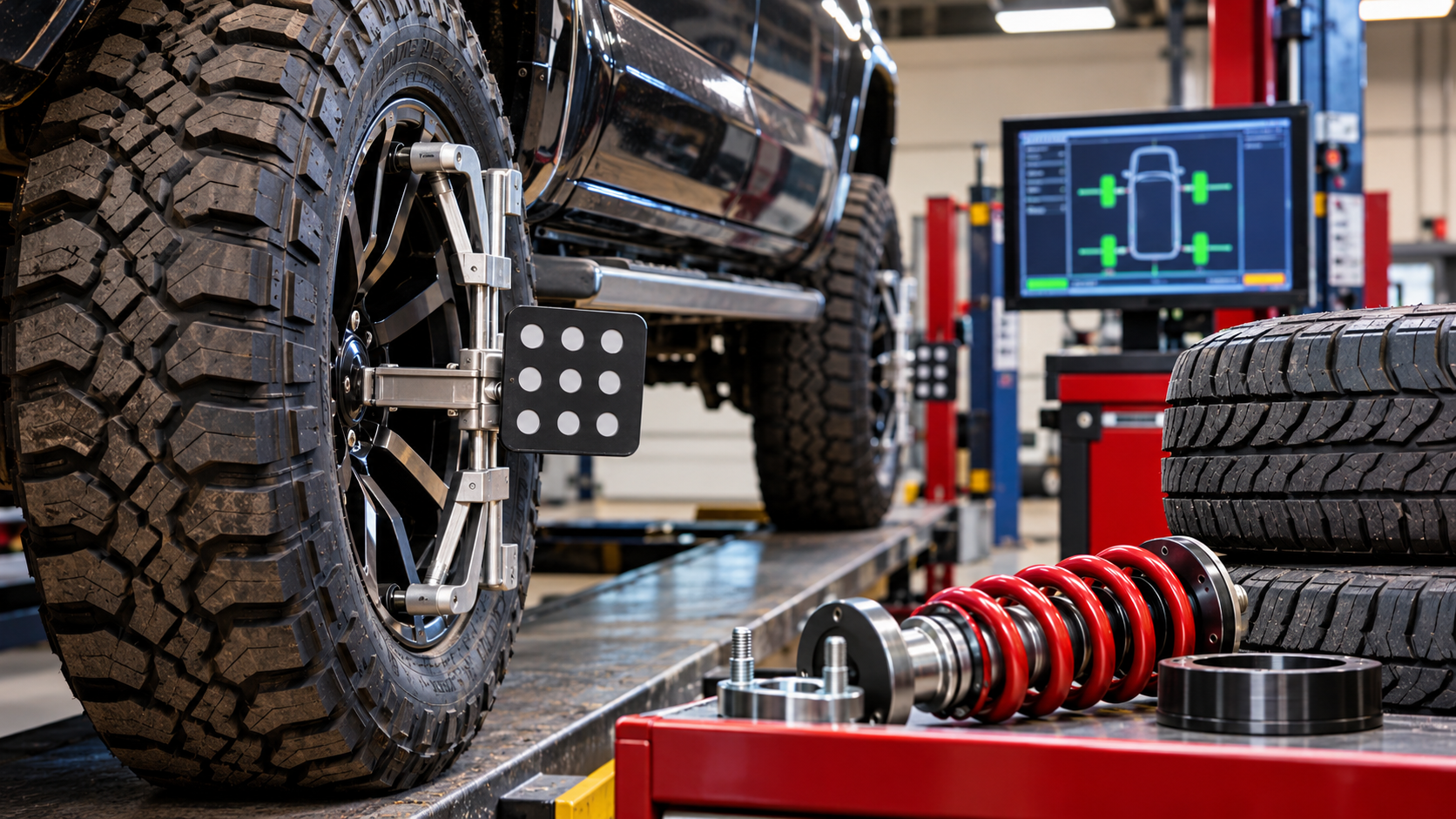
Next, your vehicle is placed on our state-of-the-art computerized alignment machine. Laser sensors are attached to each wheel to measure the exact camber, caster, and toe angles down to fractions of a degree—a level of precision impossible with DIY methods.
Our software compares these readings to your vehicle’s manufacturer specifications. Our technicians then adjust each angle to fall within the recommended range, ensuring your steering wheel is perfectly centered. Finally, we provide a printout showing the “before” and “after” measurements and take your vehicle for a test drive to confirm it handles correctly. The entire process usually takes about an hour. Learn more at our Precision Wheel Alignment & Balancing page.
How a Professional Wheel Alignment Differs from DIY Attempts
While DIY projects are admirable, wheel alignment requires precision equipment and expertise that can’t be replicated at home. Our computerized machines use lasers to measure angles to hundredths of a degree. DIY methods using string or apps lack this accuracy, and even tiny errors can cause significant tire wear and handling issues.
Our technicians have specialized training and access to up-to-date manufacturer specifications for your exact vehicle. They understand how adjusting one angle affects others and can perform the job correctly and safely. A DIY attempt risks making the problem worse, creating a vehicle that is unsafe to drive.
Two-Wheel vs. Four-Wheel Alignment: Which Do You Need?
Whether you need a two-wheel or four-wheel alignment depends on your vehicle’s suspension.
A two-wheel alignment (or front-end alignment) adjusts only the front wheels. It’s suitable for vehicles with a solid rear axle where the rear wheels are not adjustable.
A four-wheel alignment is the standard for most modern vehicles, especially those with independent rear suspension. It measures and adjusts all four wheels, ensuring they are parallel to each other. This is the best choice for optimal handling and tire life if your vehicle’s rear suspension is adjustable.
A thrust angle alignment is used for vehicles with a solid rear axle. It measures the direction the rear axle is pointing and aligns the front wheels to match, preventing the vehicle from “crabbing” down the road. Our technicians will recommend the correct service for your vehicle.
Wheel Alignment vs. Tire Balancing
Wheel alignment and tire balancing are often confused, but they solve different problems.
Wheel alignment adjusts the angles of the wheels. Symptoms of misalignment include the vehicle pulling to one side, uneven tire wear, and a crooked steering wheel.
Tire balancing ensures the weight of the wheel and tire assembly is evenly distributed. The main symptom of imbalance is vibration, usually felt in the steering wheel or seat at higher speeds.
In short, alignment affects the direction your wheels point, while balancing affects how smoothly they spin. Both are crucial for a safe ride, but they are not interchangeable. Our guide, Do You Need a Tire Balance or a Wheel Alignment?, breaks it down further.
When and Why to Get Your Wheels Aligned
Knowing when and why to get a wheel alignment can save you from costly repairs and unsafe driving conditions. Alignments are generally recommended whenever you notice uneven tire wear, your vehicle pulling to one side, or a steering wheel that isn’t centered when driving straight. They’re also wise after hitting a curb, pothole, or after suspension work, as even minor impacts can throw your angles off. Regular alignments not only extend the life of your tires but also improve fuel efficiency, enhance handling, and ensure your vehicle remains safe and responsive on the road.
How a Professional Wheel Alignment is Crucial for Your Vehicle’s Health
Your vehicle provides clear signs when its alignment is off. Look for these common symptoms:
- Drifting or pulling to one side on a straight road.
- A crooked steering wheel even when driving straight.
- Vibrations through the steering wheel (though this is also a sign of imbalance).
- Squealing tires, especially during turns.
- Uneven tire wear, such as wear on the inner or outer edges.
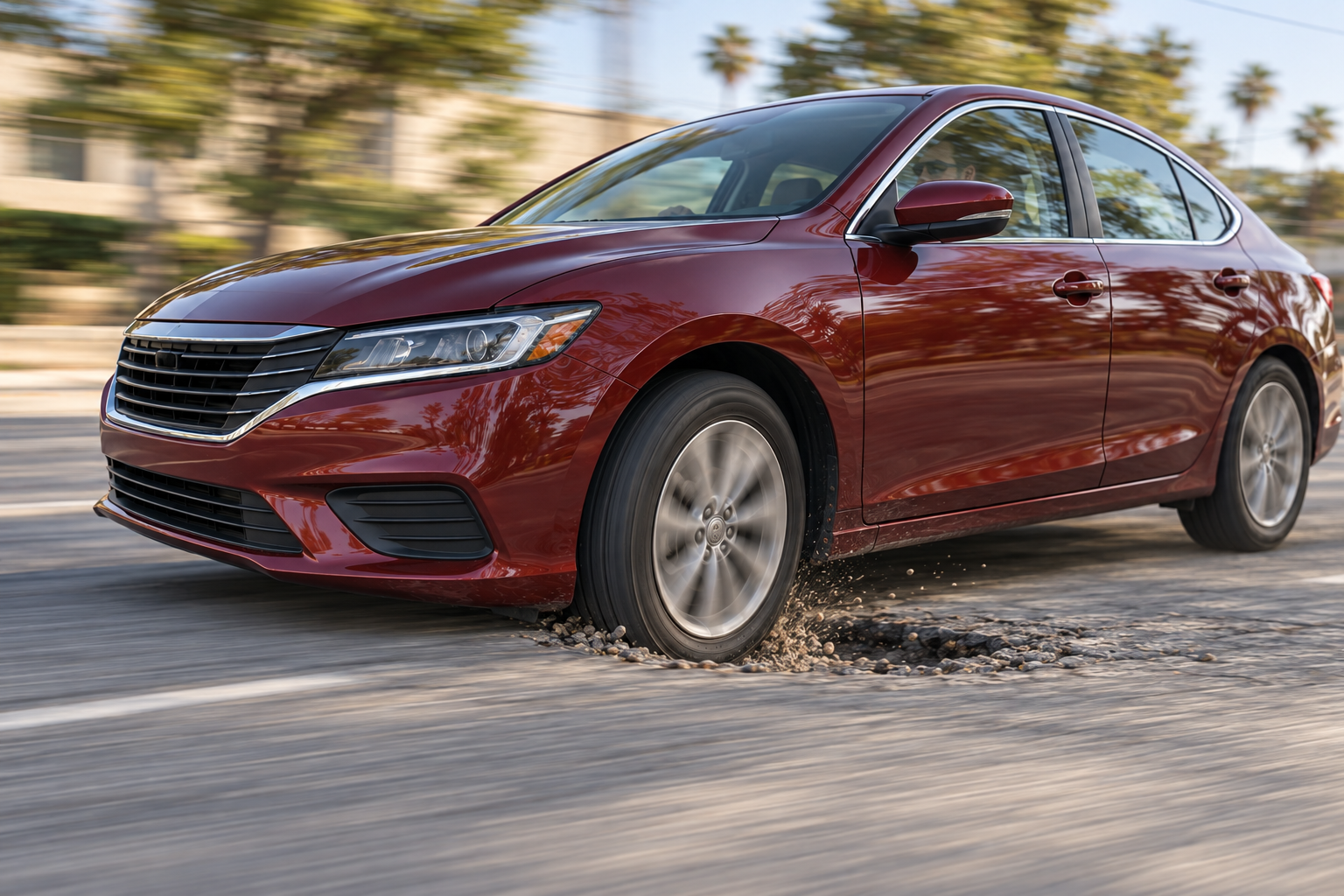
These issues are often caused by everyday driving. Hitting a significant pothole or bumping a curb can easily knock your alignment out of spec. Learn more about How Potholes Affect Wheels. Minor accidents or even the normal wear and tear on suspension components can also gradually alter your vehicle’s alignment angles.
The Critical Link Between New Tires and Alignment
Always get a wheel alignment when you install new tires. This is not an upsell; it’s about protecting your investment. New tires are a significant expense, and skipping an alignment can ruin them quickly.
An alignment ensures your new tires make even contact with the road from day one, preventing uneven wear patterns from forming. This helps you get the full lifespan you paid for. Furthermore, many tire manufacturers require proof of regular alignment checks to honor their warranties. Don’t void your warranty or shorten your tires’ life over a service that costs a fraction of their price.
Recommended Frequency and Cost-Benefit Analysis
As a general rule, we recommend an alignment check at least once a year or every 10,000 km (about 6,000-8,000 miles). You should also have it checked immediately:
- After hitting a pothole, curb, or other road hazard.
- After any suspension or steering repairs.
- When installing new tires.
- If you notice any of the warning signs mentioned above.
A professional alignment typically costs between $100 and $168. Compare this to the cost of prematurely replacing tires ($400-$1,000+) or repairing damaged suspension components ($150-$1,000+). As detailed in articles about suspension repair costs, preventative care is far more affordable.
An alignment is an investment that pays for itself by preventing costly repairs and extending the life of your tires.
Frequently Asked Questions about Professional Wheel Alignment
We’ve explained How a Professional Wheel Alignment is About More Than Just “Straight Wheels”), but you may still have questions. Here are answers to the most common ones.
How long does a professional wheel alignment take?
A standard alignment service typically takes about one hour. This includes the initial inspection, mounting the vehicle, taking measurements, making adjustments, and a final test drive.
However, if our inspection reveals worn or damaged suspension parts (like ball joints or tie rod ends), they must be replaced before we can perform an accurate alignment. This is essential for the alignment to hold properly and will extend the service time.
Can bad alignment permanently damage my tires?
Yes, absolutely. Misalignment causes uneven tread wear that is irreversible. Once a tire develops wear on its edges or bald spots, its performance is compromised, and its life is significantly shortened. The only solution is to replace the tire, meaning you’ll be buying new tires much sooner than necessary. This is why catching alignment issues early is so critical to saving money.
Is it risky to drive with misaligned wheels for a long time?
Yes, it is risky for both safety and financial reasons. Over time, the problems caused by misalignment get progressively worse.
From a safety perspective, your vehicle’s steering and control are compromised, making it less predictable in emergencies. Stopping distances can increase, and stability is reduced, especially in poor weather.
From a financial perspective, you’re not just wearing out tires faster. You’re also putting constant stress on suspension and steering components, leading to premature failure and expensive repairs. You’ll also burn more fuel due to increased rolling resistance. Postponing a $100-$168 alignment can easily lead to a $1,000+ problem down the road.
The Wheel Shop Difference
At The Wheel Shop in Riverside, CA, we have over twenty years of experience in precision alignments. Our team understands the intricate relationship between camber, caster, and toe. We use state-of-the-art computerized equipment to ensure your vehicle meets exact manufacturer specifications, not just “close enough.”
We treat your vehicle with the respect it deserves. Our commitment to craftsmanship and customer service means you’ll drive away confident in your vehicle’s performance. Waiting until you notice a problem often means the damage is already done—to your tires, your suspension, and your wallet. Preventative checks catch issues before they become expensive repairs.
Don’t let misaligned wheels silently compromise your safety and cost you money. Whether you’ve hit a pothole, installed new tires, or it’s simply been a while, now is the time to act. Schedule your precision alignment service today at The Wheel Shop and experience the difference professional expertise makes.